
The Promise That Doesn’t Deliver We’ve all been there. You crack open a novel that’s been praised to the skies for its “revolutionary narrative structure” or “bold approach to storytelling,” only to find yourself three chapters in wondering if everyone else read the same book. The critics rave about how Jennifer Egan’s A Visit from… Continue reading When Innovation Falls Flat: Why Some of Literature’s Boldest Experiments Leave Us Cold
Category: Main
When Your Favorite Author Loses Their Voice: The Heartbreak of Prose Style Evolution

The Promise We Make to Authors We fall in love with writers through their sentences. That first encounter with Toni Morrison’s biblical cadences in Beloved, or the way Kazuo Ishiguro’s restrained melancholy seeps through every line of Never Let Me Go. We make an implicit pact: you give us this voice, this particular way of… Continue reading When Your Favorite Author Loses Their Voice: The Heartbreak of Prose Style Evolution
How Writers Shed Their Skin: Tracking Prose Evolution from Debut to Masterwork
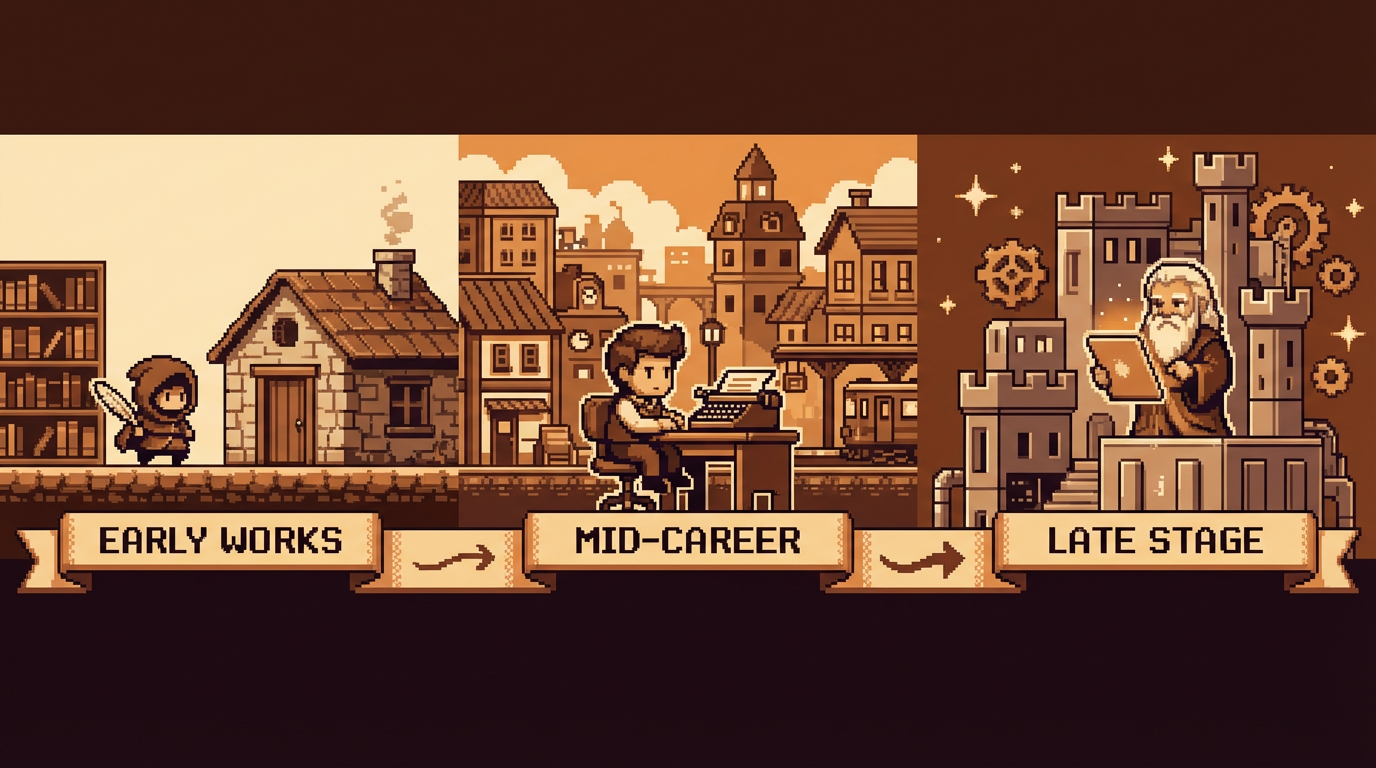
The Apprentice Voice: When Promise Meets Uncertainty Every writer begins as an imposter in their own prose. Take Zadie Smith’s White Teeth—exuberant, maximalist, crammed with cultural observations that sometimes land and sometimes don’t. The sentences sprawl like a young person trying to say everything at once. Compare this to her later On Beauty, where the… Continue reading How Writers Shed Their Skin: Tracking Prose Evolution from Debut to Masterwork
The Quiet Revolution: How Publishing’s New Realities Are Reshaping Literary Fiction

When Speed Kills Art Publishing houses are accelerating everything. Release schedules compress. Marketing windows shrink. Authors face pressure to produce novels faster than ever before. Yet literary fiction—the kind that rewards slow, careful attention—gets crushed under this velocity. The Quiet Revolution: How Publishing’s New Realities Are Reshaping Literary Fiction Think about how different Jennifer Egan’s… Continue reading The Quiet Revolution: How Publishing’s New Realities Are Reshaping Literary Fiction
The Art of Literary Deconstruction in Translation: How Contemporary Fiction Loses and Finds Itself Across Languages

When Techniques Don’t Travel: The Untranslatable Art of Style Jenny Erpenbeck’s “Kairos” won the International Booker Prize, but something essential was lost between German and English. Not plot or character development. The real casualty was Erpenbeck’s complex use of temporal fragmentation through verb tenses that simply don’t exist in English. German’s ability to layer past,… Continue reading The Art of Literary Deconstruction in Translation: How Contemporary Fiction Loses and Finds Itself Across Languages
When Genres Collide: Five Forgotten Books That Refuse to Stay in Their Lane

The Detective Who Dreamed in Poetry Nicholas Blake’s “The Beast Must Die” from 1938 reads like what would happen if Dorothy Sayers decided to write psychological horror. Blake was actually Cecil Day-Lewis, the future Poet Laureate, moonlighting in crime fiction. But calling this just a detective novel misses the point entirely. When Genres Collide: Five… Continue reading When Genres Collide: Five Forgotten Books That Refuse to Stay in Their Lane
When Promising Debuts Disappear: The Strange Afterlife of Literary First Novels
The Vanishing Act In 1982, a 28-year-old insurance adjuster named David Foster Wallace published his debut novel through a small press in Boston. The Broom of the System sold fewer than 2,000 copies in its first year. By 1987, most bookstores had remaindered their copies. Today, first editions sell for $3,000. This trajectory shows the… Continue reading When Promising Debuts Disappear: The Strange Afterlife of Literary First Novels
Why Your Reading List Needs More Literary Magazines: A Curated Path Through Small Press Territory

The Gateway Problem: Where Literary Discovery Actually Happens You know that feeling when you stumble across a story so perfectly crafted it stops you mid-sentence? The one that makes you immediately flip to the contributor notes to see what else this writer has published? Nine times out of ten, you found that story in a… Continue reading Why Your Reading List Needs More Literary Magazines: A Curated Path Through Small Press Territory
When Words Cross Borders: What Authors Really Think About Translation
The Untranslatable Moment During a recent conversation with Estonian novelist Andrus Kivirähk, I asked about the English translation of his darkly comic The Man Who Spoke Snakish. His response caught me off guard. “The translator had to invent new swear words,” he said, laughing. “Estonian has very specific profanity tied to our pagan past. Matthew… Continue reading When Words Cross Borders: What Authors Really Think About Translation
When Stories Break Their Own Rules: How Contemporary Authors Are Rewriting Narrative DNA
The Constraint Revolution: Why Rules Make Better Rebels Every story needs bones. Traditional narrative structure gave us those bones: setup, confrontation, resolution. Character arcs that bend toward change. Chronology that moves forward like a well-behaved clock. But something fascinating happens when contemporary authors start breaking those bones deliberately, surgically, with full knowledge of what they’re… Continue reading When Stories Break Their Own Rules: How Contemporary Authors Are Rewriting Narrative DNA