The Apprentice Voice: When Promise Meets Uncertainty
Every writer begins as an imposter in their own prose. Take Zadie Smith’s White Teeth—exuberant, maximalist, crammed with cultural observations that sometimes land and sometimes don’t. The sentences sprawl like a young person trying to say everything at once. Compare this to her later On Beauty, where the same observational gifts operate with surgical precision. The difference isn’t talent. It’s the confidence to cut.
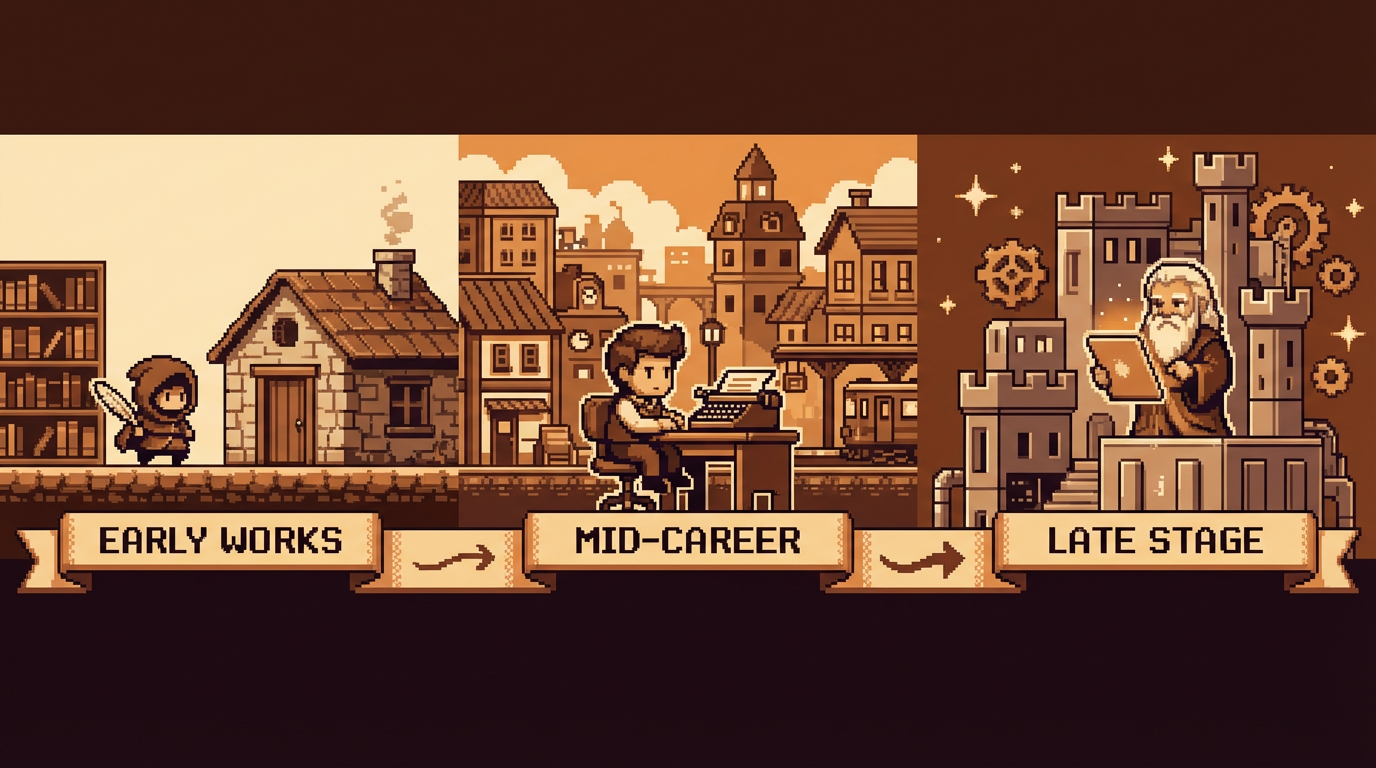
This pattern repeats across genres. Michael Crichton’s early thrillers overflow with technical exposition, as if he’s proving his research credentials on every page. Stephen King’s Carrie shows flashes of his later psychological insight, but it’s wrapped in B-movie plotting that suggests he’s still figuring out what kind of horror writer he wants to be. Science fiction debuts often get crushed under worldbuilding overload. Authors construct elaborate universes but forget to inhabit them with convincing human voices.
The apprentice voice carries a particular vulnerability. These writers haven’t yet learned that readers will follow a confident narrator anywhere, but will abandon a hesitant one immediately. Early prose hedges its bets. It qualifies statements that would hit harder delivered straight. The difference between “She was probably the most beautiful woman he had ever seen” and “She was the most beautiful woman he had ever seen.” One whispers. The other commands.

The Confidence Trap: When Writers Discover Their Power
Success can be its own kind of prison. After a breakthrough novel, many writers develop what I call the “signature voice trap.” They discover what works and repeat it until it becomes parody. Tom Clancy’s later novels read like Mad Libs versions of The Hunt for Red October. The precision that made his early technothrillers compelling became mechanical reproduction.
Genre writers face this trap more obviously than literary authors, but it affects everyone. Romance authors who find their formula often can’t evolve beyond it. Mystery writers become prisoners of their own procedural success. But literary fiction isn’t immune. Consider how some celebrated authors begin writing elaborate variations on their prize-winning debut. Each new novel becomes a more ornate version of the same underlying structure.
The trap shows up in prose that’s too comfortable with its own effects. Sentences that once crackled with discovery now perform familiar tricks. Dialogue that once surprised readers becomes predictable. The writer has learned their craft so well they’ve forgotten why they started writing in the first place.
Breaking Through: When Constraints Force Innovation
The most interesting prose evolution happens when writers deliberately break their own patterns. Jennifer Egan followed the complex plotting of A Visit from the Goon Squad with The Candy House, refusing to repeat her Pulitzer-winning formula. Instead, she pushed further into structural experiment. She used the constraints of social media-age storytelling to force new kinds of prose rhythms.
Genre constraints can produce unexpected innovation. When Ursula K. Le Guin moved from fantasy to science fiction to literary fiction and back, each genre demanded different prose strategies. Her Earthsea fantasy needed the cadences of oral tradition. Her science fiction needed the clarity of thought experiments. Her literary work allowed for more impressionistic effects. Rather than watering down her voice, these constraints sharpened it.
The most successful prose evolution often means embracing limitations. Donald Westlake wrote comic crime novels under his own name and hard-boiled thrillers as Richard Stark. The constraints of each genre forced him to develop distinct prose styles. Comedy’s need for timing. Noir’s demand for emotional distance. Eventually, these techniques cross-pollinated his work under both names.
Mastery and Risk: The Late Style Phenomenon
Late-career prose often takes on a quality of fearless simplicity. Writers who have spent decades mastering complex techniques suddenly strip everything away. Joan Didion’s late essays achieve devastating effects with sentences of almost childlike directness. Elmore Leonard’s final novels read like masterclasses in how much you can accomplish with “he said” and “she said.”
This isn’t decline. It’s distillation. Writers who have proven they can handle any technical challenge lose interest in showing off. They want to say exactly what they mean with no wasted motion. The prose becomes transparent in the way that only supreme craft can achieve. Every word carries weight precisely because no word is wasted.
Sometimes late-period experiments fail spectacularly, but the failures are often more interesting than safe successes. Philip Roth’s Exit Ghost reads like an author deliberately dismantling his own fictional methods. Joyce Carol Oates continues reinventing her prose style with each new novel. Some experiments work better than others, but all of them reveal an author who refuses to coast on past achievements.
The Reader’s Journey: Learning to See Evolution
Understanding prose evolution changes how we read. Instead of judging each book as an isolated artifact, we begin to see careers as ongoing conversations between writer and craft. Toni Morrison’s first novel The Bluest Eye contains DNA for everything she would later accomplish. But reading it after Beloved reveals how much she had to learn about trusting her own voice.
The best way to track this evolution? Chronological reading. Follow a writer’s complete works in order rather than cherry-picking the acclaimed titles. You’ll see techniques developing, voices finding their range, experiments that succeed or fail but always teach something. You’ll understand not just what makes great prose great, but how it got that way through years of trial, error, and gradual discovery.
What writers are you curious to follow from debut to latest work? The journey reveals as much about the craft of writing as any single masterpiece. It often makes you appreciate both the early promise and the mature achievement in entirely new ways.